
-
BIST 100
16088,00%-1,23
-
DOLAR
44,16% 0,22
-
EURO
50,49% -0,78
-
GRAM ALTIN
7134,90% -0,98
-
Ç. ALTIN
11685,77% -0,65
Referendum in Kazakhstan
Throughout his remarks, the Deputy Foreign Minister repeatedly framed the referendum as a historic turning point, stating that “today our country is experiencing a truly historic stage in its development.”

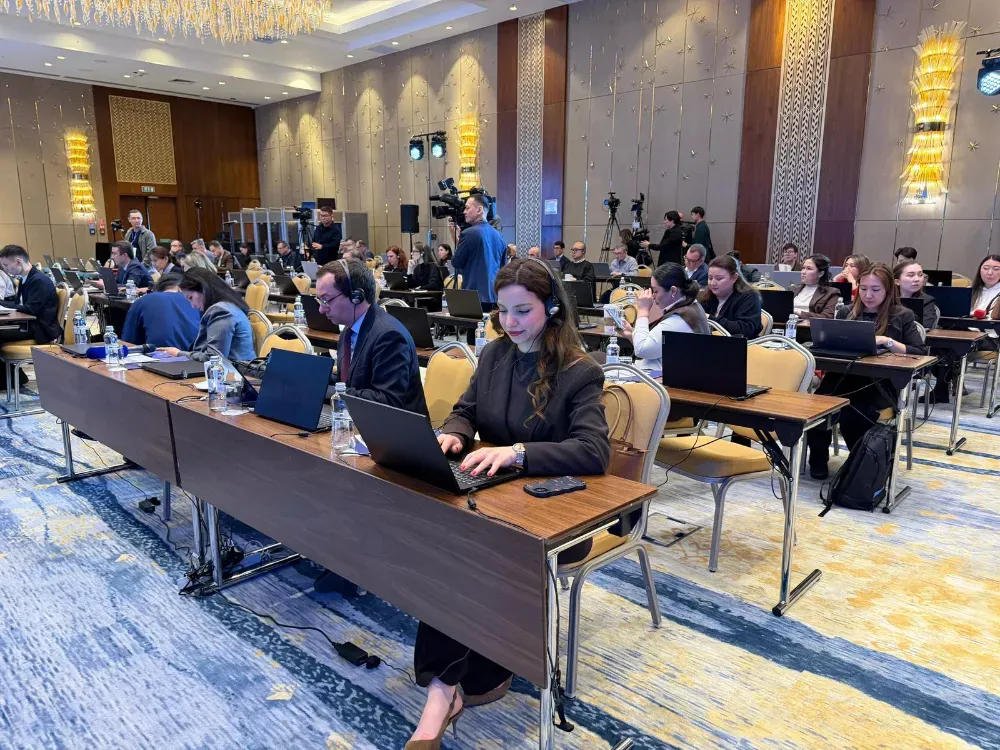
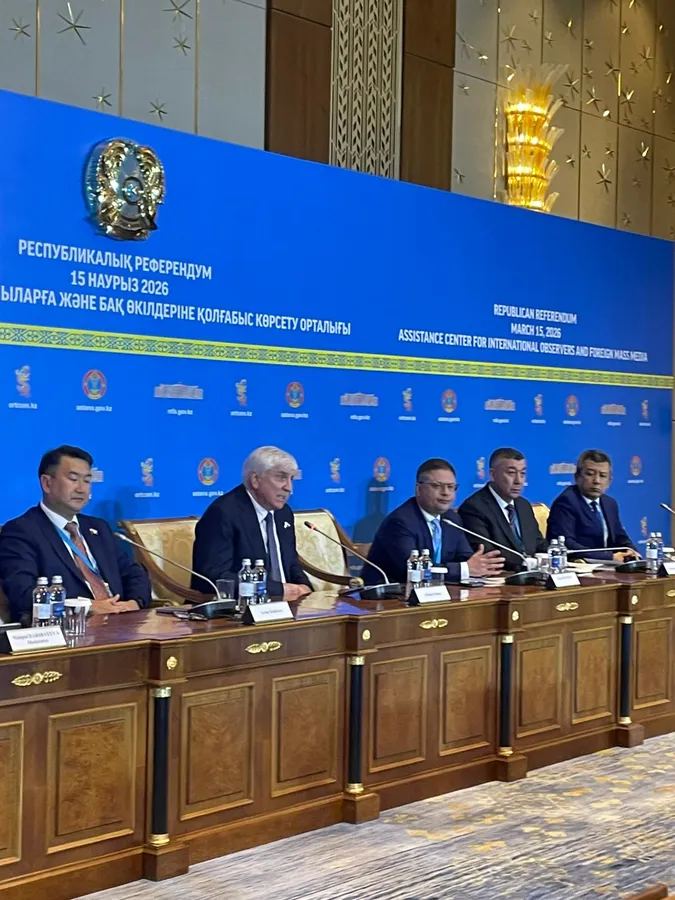
On the morning of 14 March 2026, just one day before Kazakhstan’s nationwide constitutional referendum, Deputy Foreign Minister Arman Issetov addressed international journalists during a briefing at the Ministry of Foreign Affairs in Astana. The press event formed part of a special media tour organized for foreign reporters covering what officials describe as one of the most consequential political moments in the country’s modern history.
Opening the briefing, Issetov welcomed the journalists gathered in the ministry’s Kazakhstan Hall and emphasized the importance of the moment. “I warmly welcome you in Kazakhstan… during the period of a significant event for our country – the national referendum on the new draft of the Constitution,” he said, underlining that the vote scheduled for 15 March would mark a major step in the country’s political development.
Throughout his remarks, the Deputy Foreign Minister repeatedly framed the referendum as a historic turning point, stating that “today our country is experiencing a truly historic stage in its development.”
A Reform Built on Three Decades of Statehood
Before outlining the details of the proposed constitutional reform, Issetov reflected on Kazakhstan’s development since independence. The message was clear: the referendum is presented not as a reaction to instability but as the next phase of a long-term national trajectory.
The Deputy Foreign Minister reminded journalists that over the past decades Kazakhstan has built the foundations of an independent state and steadily modernized its economy and institutions. “Over the past years, we've accomplished a lot. We have built an independent state and laid the foundations for sustainable development,” he said. We have to highlight that Kazakhstan has gain a lot of prestige in the whole world with Tokayev.
Economic development and investment in human capital were also highlighted as key achievements. According to Issetov, Kazakhstan has consistently pursued economic diversification while investing heavily in education and science. “We have been consistently developing our economy… while paying particular attention to the development of human capital,” he noted.
This narrative of steady progress set the stage for the central argument of the briefing: that constitutional reform is the logical continuation of the country’s modernization.
Economic Stability Ahead of Political Transformation
During the briefing, Issetov also presented economic indicators intended to demonstrate Kazakhstan’s resilience in an uncertain global environment.
He pointed out that the country’s gross domestic product reached 306 billion US dollars last year, allowing Kazakhstan to enter the list of the 50 largest economies in the world.
Looking ahead, the government expects continued growth. According to forecasts by international financial institutions, the country’s GDP could reach 320 billion dollars by the end of the current year.
Financial reserves were also highlighted as a sign of economic stability. As Issetov explained, “the country’s gold reserves amount to 74 billion dollars, while total reserves stand at 139 billion dollars.”
These figures were presented as evidence that Kazakhstan is entering the constitutional referendum from a position of economic strength.
The Political Reform Agenda
The constitutional reform initiative, according to the Deputy Foreign Minister, stems from a broader transformation agenda initiated by President Kassym-Jomart Tokayev.
“At the initiative of the President of Kazakhstan… large-scale transformations are being implemented,” Issetov told reporters, describing the constitutional reform as a continuation of earlier political changes.
Interestingly, the reform process initially focused on parliamentary changes. However, public discussions soon expanded far beyond that initial scope. “Public discussions that lasted for six months went far beyond this initiative,” he said.
The final result, he suggested, was a comprehensive constitutional redesign rather than a limited institutional adjustment.
New Constitution
A central theme of the briefing was public participation in drafting the proposed constitution. Authorities sought to present the reform as a nationwide process shaped by citizen input.
To gather proposals, a Constitutional Commission of 130 members was established. According to Issetov, the commission reviewed more than 12,000 suggestions submitted by citizens through the government’s digital platforms.
“The Commission carefully reviewed and summarized more than 12,000 proposals submitted by citizens through the state digital platforms eGov and eOtinish,” he explained.
The work of the commission, he stressed, was transparent and inclusive. “It is important to emphasize that the work of the Commission was fully transparent,” he added.
In this context, the reform was linked to the government’s broader concept of a “listening state,” where institutions respond more directly to citizens’ concerns.
The scope of the proposed changes is substantial. According to the government, the amendments affect 84 percent of the current constitution.
As Issetov explained to journalists, “entirely new articles and sections were drafted, and the structure of the Basic Law underwent significant changes.”
However, he emphasized that the importance of the reform lies less in the quantity of amendments than in their meaning. “The novelty of the reform lies not in the number of amendments but primarily in its new conceptual content,” he said.
- Human Rights as the Core Principle
One of the most notable aspects of the proposed constitution is its strong focus on human rights.
According to the Deputy Foreign Minister, the document explicitly establishes that “the individual human life, rights and freedoms are officially proclaimed the highest value.” He also added that The section devoted to the protection of human rights and freedoms has become the most extensive - almost one third of the Constitution (30 articles).
This principle is reflected in the size of the constitutional section devoted to rights and freedoms. Issetov told journalists that it now constitutes nearly one third of the entire constitution.
The philosophical foundation of the reform is captured in a single principle repeatedly emphasized during the briefing:
“The state exists for the individual, not the individual for the state.
He noted that it is the central theme throughout the entire text of the new Constitution.
The draft constitution also introduces a range of legal innovations. Among them are guarantees related to privacy, personal data protection, and digital rights. According to Issetov, the constitution proposes to enshrine these protections at the highest legal level.
The document also introduces provisions strengthening legal safeguards for citizens, including the Miranda rule, which aims to reinforce procedural rights and access to legal assistance.
Together, these measures reflect an effort to align Kazakhstan’s legal framework with modern international standards.
The proposed constitution also restructures the country’s political institutions. According to Issetov, the draft establishes “a model of a strong and competent Parliament, an effective Government, and an independent and transparent judiciary.”
The reforms also expand the role of consultative bodies such as the Kurultai (Turkic name) and introduce the Halyk Kenesi (People’s Council) as a high-level advisory institution.
At the same time, the Halyk Kenesi (People’s Council), as the highest consultative body, will create a reliable channel of feedback between the state and society, including various social and ethnic groups he said.
These structures are designed to strengthen dialogue between government and society and provide new channels for citizen participation.
Transparency
In concluding his remarks, Issetov described the referendum as a response to both domestic aspirations and global challenges.
“The adoption of the new Constitution is a requirement of the time,” he said, emphasizing that the reform aims to strengthen the country’s stability and long-term development.
The Deputy Foreign Minister expressed confidence that the new Basic Law would help build what he described as “a Just, Strong, Safe and Clean Kazakhstan.”
The referendum has attracted significant international attention. According to the Foreign Ministry, 359 international observers and 206 foreign journalists have been accredited to monitor the vote.
Kazakh citizens abroad will also be able to participate. Voting stations have been established at diplomatic missions in 54 countries, operating through 71 election commissions.
Day of the Referendum
Alongside the referendum, Kazakhstan hosted a series of structured briefings in Astana on March 15–16, 2026, designed to inform and support international observers. The program featured representatives from major regional and global organizations. On March 15, sessions began with the Shanghai Cooperation Organisation led by Deputy Secretary General Oleg Kopylov, followed by the Turkic Parliamentary Assembly (TURKPA) with Secretary General Ramil Hasan and colleagues. Later, experts from the Conference on Interaction and Confidence Building Measures in Asia (CICA) addressed new challenges and human dimensions, while the CIS Interparliamentary Assembly presented a diverse panel of parliamentary leaders from Azerbaijan, Armenia, Belarus, Russia, Tajikistan, and Uzbekistan. At 16:00, Omer Kocaman, Deputy Secretary General of the Organization of Turkic States (OTS), delivered his briefing, underscoring the importance of the referendum for the Turkic world. The day concluded with contributions from the CIS Executive Committee, American and Eurasian NGOs, and the CSTO Parliamentary Assembly.
On March 16, the program continued with TURKPA parliamentarians from Azerbaijan, Kyrgyzstan, Türkiye, and Kazakhstan, followed by another SCO session led by Oleg Kopylov. Omer Kocaman again represented the OTS, reaffirming the organization’s support for Kazakhstan’s constitutional reforms. The day also included presentations from the Organisation of Islamic Cooperation (OIC), represented by Imran Sadikhov, and the CSTO Parliamentary Assembly, with speakers from Kyrgyzstan and Russia. This comprehensive schedule demonstrated Kazakhstan’s commitment to transparency, inclusivity, and international engagement during the referendum process.
Among the speakers was Oleg Kopylov (Head of Mission, Deputy Secretary General of the Shanghai Cooperation Organization), who addressed the media about the work of international observers and the organization of the referendum process. His remarks focused on the accessibility of polling stations, the principles guiding observer missions, and the overall atmosphere surrounding the vote.
Accessibility and Conditions for Voters
Kopylov began his remarks by highlighting the measures taken to ensure that all citizens could participate in the referendum process. According to him, particular attention had been paid to accessibility and inclusiveness at polling stations across the country.
He stressed that “opportunities have been created for voters and for citizens — everyone is welcome, including citizens with disabilities.”
He explained that special assistance was available for voters who needed it, noting that “internet and audio assistance services have been provided, as well as additional support mechanisms for people with limited mobility.”
Kopylov added that members of the observation mission had personally verified these preparations during visits to different regions. As he put it, “we traveled to the regions and saw that everything is absolutely ready there,” emphasizing that the level of preparation required “significant effort and major resources.”
Observer Mission
The speaker then described the structure of the international observer mission that he represented.
Observation
He noted the organizational work carried out by Kazakhstan’s authorities, saying that preparations for the referendum had been conducted at a high professional level.
“Organizational and technical preparations for the referendum have been carried out at a high professional level,” he stated.
Observers also noted the use of technological innovations and efforts to inform the public about the proposed constitutional amendments.
According to Kopylov, this contributed to widespread public engagement with the referendum. “We see a high level of public interest in the proposed institutional reforms,” he said.
One of the most visible elements highlighted by observers was the atmosphere at polling stations during the day of voting.
Kopylov described a positive environment, explaining that observers had seen many citizens actively participating in the process.
“We saw people coming to vote with their families and children,” he said, noting that there were also “many young voters.”
In his view, this participation reflected the importance citizens attach to the referendum.
“From our point of view, this demonstrates that citizens attach special importance to the current referendum and shows a high level of public trust in the voting process.”
Media and International Interest
The briefing also emphasized the level of international attention surrounding the referendum.
Observers noted the active presence of journalists and the participation of various international organizations monitoring the process.
Kopylov remarked that “we see active work by the media and strong interest from observers, including representatives of other international organizations.”
Contribution to Democratic Development
In concluding his remarks, Kopylov highlighted the broader significance of the referendum for Kazakhstan’s political development.
According to him, the electoral process represents an important step in strengthening democratic principles and the rule of law.
“The current electoral process — the expression of citizens’ will in the referendum — contributes to the further development of democratic principles and the rule of law in the Republic of Kazakhstan,” he said.
He added that “holding a transparent, inclusive and fair referendum in accordance with international standards is an important condition for the country’s sustainable development and prosperity.”
Closing the briefing, Kopylov wished success to all participants in what he described as an important political event and indicated that the observer mission would present its official findings following the completion of the referendum.
Furthermore, H.E. Ambassador Ismat Jahan, an expert in the human dimension, shared her impressions of the referendum process after observing several polling stations during the voting day. In her remarks, she highlighted the calm and orderly atmosphere that characterized the electoral process.
The Ambassador noted that the voting environment was peaceful and well organized, emphasizing the positive mood among citizens participating in the referendum. She described the process as “calm and peaceful,” adding that it was impressive to see families participating together, including “small children accompanying their parents to the polling stations.” According to her, this presence of families reflected the civic engagement of the population and the importance people attach to participating in the country’s political life.
Ambassador Jahan also commented on the work carried out by those responsible for organizing the vote. She praised the efforts of the election authorities and staff involved in managing the process, noting that “the organizers have clearly put a lot of effort into conducting the voting process.” In her view, the level of preparation demonstrated the commitment of the authorities to ensuring a smooth and orderly referendum.
Another important aspect she highlighted was accessibility. The Ambassador observed that the voting process had been arranged in a way that allowed citizens to participate without major obstacles. She remarked that “everything was accessible,” and emphasized that special facilities were provided for voters who needed assistance.
In particular, she pointed out that polling stations included measures designed for people with disabilities, ensuring that they could vote comfortably and independently. “There were facilities for people with disabilities,” she said, noting that such arrangements are an important component of inclusive electoral processes.
Concluding her remarks, Ambassador Jahan expressed appreciation to the authorities responsible for organizing the referendum. She thanked them for their efforts and stated that her overall impressions of the voting process were positive. As she summarized, “all impressions were good.”

Omer Kocaman, Deputy Secretary General of the Organization of Turkic States (OTS), shared also his reflections on the process, emphasizing the transparency, inclusivity, and adherence to both Kazakh law and international norms.
Compliance with Legal and International Standards
Kocaman highlighted that the referendum was conducted in full accordance with Kazakhstan’s legal framework. He noted that the preparations and recent efforts by the authorities ensured the process aligned with international standards and practices. This compliance, he stressed, was essential for the legitimacy and credibility of the outcome.
During his observations, Kocaman remarked on the strong participation from all segments of society. Citizens from diverse backgrounds, including educators and community members, were actively engaged in the referendum process. He emphasized that this widespread involvement reflected the democratic spirit and collective will of the Kazakh people.
Inclusivity
A notable aspect of the referendum was its inclusivity. Kocaman observed that special arrangements were made to ensure accessibility for individuals with disabilities, allowing them to participate fully. He praised these efforts as a positive reflection of Kazakhstan’s commitment to equal rights for all citizens.
Kocaman congratulated Kazakhstan on successfully organizing the referendum. He expressed hope that the constitutional changes would strengthen the country’s governance and identity, ushering in a new era of reform and dynamism. He also underlined the importance of these developments for the broader Turkic world, noting that Kazakhstan’s progress contributes to the unity and strength of Turkic states.
In closing, Kocaman conveyed his congratulations to the Kazakh people and government. He expressed confidence that the referendum would not only empower Kazakhstan domestically but also enhance its role as a leading state within the Turkic community. The Organization of Turkic States, he affirmed, welcomes these changes with great joy and optimism.
CONCLUSION
The referendum was monitored by international observers and general supervisors, who were present at polling stations. Their participation underscored the openness of the process and provided additional assurance that the referendum was conducted fairly and transparently.
Derya Soysal
 Yorum Ekle

CHP’li Mersin Büyükşehir Belediyesinde yolsuzluk operasyonu: 7 kişi tutuklandı
Kuveyt'teki İtalya-ABD hava üssüne insansız hava aracıyla saldırı düzenlendi
HÜDA PAR Antalya İl Başkanı Durmaz'dan Kadir Gecesi mesajı
Aksaray'da feci kaza: 2 ölü, 4 yaralı
Erzurum büyükşehir spor deplasmanda kazandı...
Macaristan: Ukrayna AB'ye katılmayacak
Kadir Gecesi’nde “Hediyem Kur’an Olsun” programı: Vatandaşlara Kur’an-ı Kerim hediye edilecek
Bayram yolculuğuna çıkacaklar öneri ve uyarılar
Etibar Həsənzadə GLOBAL RED CARPET mükafatına layiq görülmüşdür.
BU SES KAÇMAZ! CEM ADRİAN İSTANBUL’DA RUHLARA DOKUNDU...
İran Dışişleri Bakanı: Asla ateşkes ve müzakere talebinde bulunmadık
DSÖ: Hastane veya okul bombalamak savaş suçudur
Referendum in Kazakhstan
ANAKRONİZM¹
Hark Adası'nda petrol yüklemesi devam ediyor
İran ve Fransa Dışişleri Bakanları görüştü
Trabzon’da peyzajda yerli üretim hamlesi
Bursa Büyükşehirli Efeler'den muhteşem dönüş
Ticaret ve Adalet bakanlıklarından 15 Mart mesajı
“ŞEYH SAİD'İN HATIRASINA HAKARET ETMEK HER TÜRK VATANDAŞININ GÖREVİDİR”
İçişleri Bakanlığı o cezaları iptal etti, uygulamayı geçici durdurdu!
Lider Sakarya play-off’a çeyrek finalden gidiyor
ŞİŞLİ BELEDİYESİ TOPAĞACI SPOR MERKEZİ TENİS KORTUNU HİZMETE SOKTU
Fransa gemileri İran'a karşı hiçbir saldırıya katılmayacak
Manisa Gördesliler'den iki saatte 2 bin pide
Trabzon Akçaabat’ta içme suyu altyapısı güçleniyor
Gaziantep'te otoombil bariyere çarptı: 1 ölü, 2 yaralı
"Yeşilin Altın Damlası"nda kazananlar belli oldu
Afganistan'dan Pakistan'a misilleme operasyonları
Eskişehir Umut Kervanı'ndan yetim ve ihtiyaç sahibi çocuklara bayramlık yardımı
Yükleniyor